CogVLM: Tsinghua's Open-Source Vision-Language Model with Deep Fusion Architecture
Discover CogVLM, the open-source vision-language model from Tsinghua University's THUDM lab. Learn about its deep fusion architecture, key features, and use cases for multimodal AI.
What Is CogVLM?
CogVLM is a state-of-the-art open-source visual language model developed by Tsinghua University's THUDM lab. With over 6,700 stars on GitHub, it represents one of the most capable open multimodal AI systems available today. Unlike earlier vision-language models that combine a pre-trained vision encoder with a frozen language model, CogVLM introduces a deep fusion architecture where visual and language features interact at every transformer layer, enabling significantly deeper multimodal understanding.
🚀 Explore CogVLM on Run This Ai
Docker Compose configs, system requirements, and more — all in one place.
View CogVLM Tool Page →Key Features
- Deep Fusion Architecture: CogVLM doesn't just attach a visual encoder to an LLM — it deeply fuses visual and textual information across all transformer layers, resulting in more coherent multimodal reasoning.
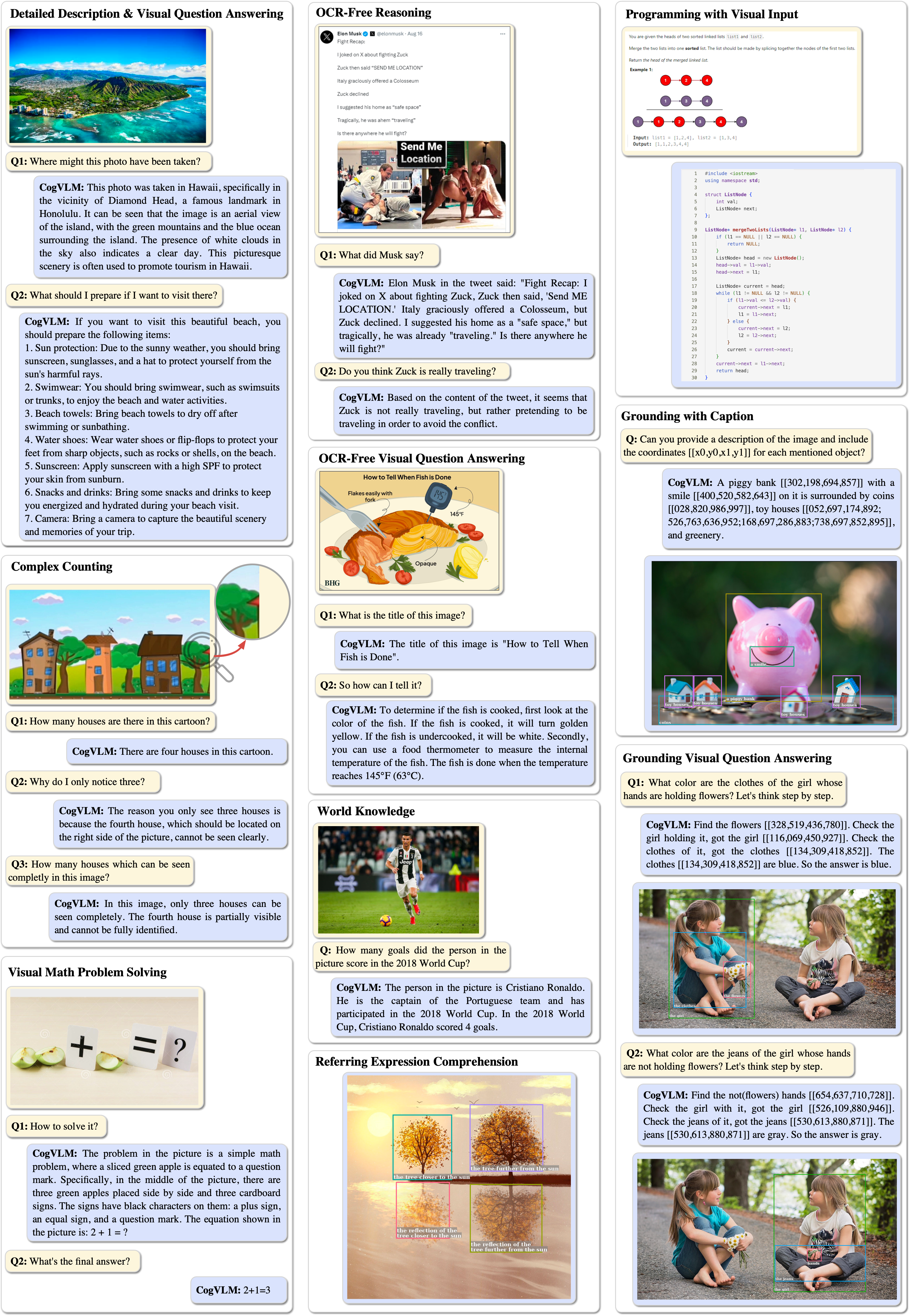
- Visual Question Answering: Ask questions about images and get accurate, context-aware answers. CogVLM achieves top-tier results on benchmark VQA datasets.
- Image Captioning: Generate detailed, accurate captions for any image, describing objects, actions, scenes, and relationships.
- Visual Grounding: The model can identify and localize specific objects mentioned in text within an image, bridging vision and language at a fine-grained level.
- Fully Open Source: Licensed under Apache-2.0 with PyTorch implementation, making it accessible for research, fine-tuning, and deployment.
Architecture Deep Dive
What makes CogVLM special is its approach to multimodal fusion. Most vision-language models use a "shallow fusion" approach where visual features from an image encoder are projected into the language model's embedding space, but the language model's weights remain frozen. CogVLM takes a different path: it uses a trainable visual expert module that integrates into every layer of the language model, allowing visual and language representations to influence each other at every stage of processing. This results in superior performance on tasks requiring fine-grained visual understanding.
Use Cases
- Research & Education: CogVLM powers experiments in multimodal learning, visual reasoning, and human-AI interaction.
- Content Moderation: Analyze images for policy violations with detailed visual understanding.
- Accessibility: Generate image descriptions for visually impaired users.
- Automation: Extract structured information from documents, screenshots, and diagrams.
- Robotics: Provide visual grounding for robotic systems that need to understand their environment.
Why Self-Host CogVLM?
Running CogVLM locally gives you complete control over your data, no API costs, and the ability to fine-tune the model on your own datasets. As an Apache-2.0 licensed model, there are no usage restrictions — ideal for commercial applications and privacy-sensitive workloads.
Conclusion
CogVLM is a landmark achievement in open-source multimodal AI, offering deep vision-language fusion that rivals proprietary systems. Whether you're building a visual assistant, conducting multimodal research, or automating image understanding workflows, CogVLM provides a powerful foundation that's both accessible and highly capable.
🚀 Explore CogVLM on Run This Ai
Get the full tool page with Docker Compose configs, system requirements, and more.
View CogVLM Tool Page →