Dragonfly: The Ultra-Fast Redis Alternative Powering AI Workloads
Learn about Dragonfly — the high-performance Redis-compatible in-memory data store with vector search for AI workloads. 25X more throughput, 80% less resources.

What Is Dragonfly?
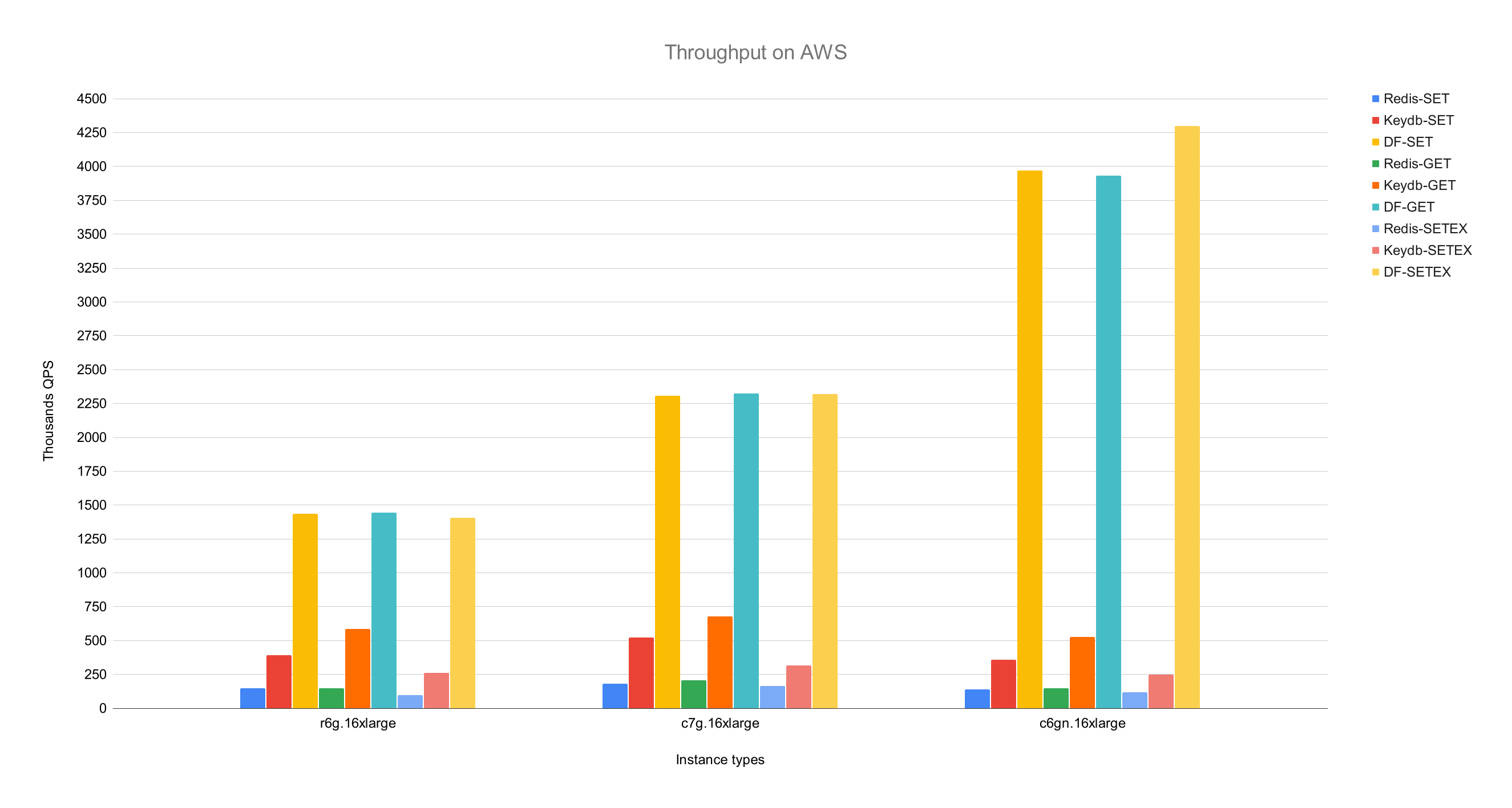
Dragonfly is a modern in-memory data store that serves as a high-performance drop-in replacement for Redis and Memcached. Built from the ground up for multi-core processors, it delivers up to 25X more throughput than legacy in-memory datastores while using up to 80% less hardware resources. With over 30,000 GitHub stars, Dragonfly has quickly become the go-to choice for teams that need maximum performance from their caching, session, and real-time data layers.
What makes Dragonfly especially relevant for AI applications is its built-in vector search capability. Using HNSW (Hierarchical Navigable Small World) indexes, Dragonfly enables fast similarity search — critical for RAG pipelines, embeddings lookup, and semantic caching — without needing a separate vector database.

Key Features
Blazing Performance
Dragonfly uses a shared-nothing architecture and I/O uring on Linux to achieve 3.8M QPS on a single node with far fewer CPU cores than Redis, making it remarkably cost-effective at scale.
Full Redis and Memcached Compatibility
Switch to Dragonfly without changing application code. It supports all major Redis commands, RESP2/RESP3 protocols, transactions, pub/sub, Lua scripting, and the Memcached ASCII and binary protocols.
Vector Search with HNSW
Dragonfly supports HNSW-based vector indexing and similarity search via Redis-compatible commands. Store embeddings from your LLM pipeline and query them with cosine similarity, inner product, or L2 distance — all within Dragonfly's high-performance memory engine.
Replication and Persistence
Dragonfly supports leader-follower replication, RDB snapshotting, and AOF persistence to ensure data durability. Automatic failover enables high availability.
Why Use Dragonfly for AI?
AI workloads demand speed. Use Dragonfly as a semantic cache for LLM responses — store embeddings and retrieve similar results in milliseconds. Use it as a vector store for RAG pipelines alongside LangChain, LlamaIndex, or Haystack. And use it as the high-speed data layer that keeps your application responsive under load.
Conclusion
Dragonfly redefines what an in-memory data store can do. Whether you are scaling a traditional Redis workload or building AI-powered applications, Dragonfly offers unmatched performance, zero migration cost, and vector search built right in. Companies like Booking.com, X.AI, and Instacart run it in production.