Graphiti: Build Temporal Knowledge Graphs for AI Agents
Learn how Graphiti uses temporal context graphs to give AI agents real-time, evolving knowledge with automatic fact invalidation and hybrid retrieval.

🤔 The Problem: Your AI Agent Has No Memory of Time
I've been building AI agents for a while now, and there's one thing that kept driving me crazy: agents don't understand time. Ask your chatbot what it knows about a user, and it'll give you a flat blob of facts — some from 2024, some from last week, all jumbled together.
Last month, I was working on a customer support agent for a SaaS product. The agent kept telling users about features that were deprecated six months ago. Why? Because it couldn't tell when a fact was true. That's not memory — that's a filing cabinet with no dates.
🚀 Want to deploy Graphiti yourself?
Docker configs, system requirements, and installation guides — all on one page.
View Graphiti Tool Page →🏗️ Enter Graphiti: Temporal Context Graphs Done Right
Graphiti is an open-source framework (28.4K ⭐ on GitHub, Apache-2.0) that builds temporal context graphs for AI agents. The key word is temporal. Unlike knowledge graphs that store a static snapshot, Graphiti tracks when facts are true, when they change, and why they were replaced.
Think of it this way: a regular knowledge graph is a photo album — you see one version of reality. Graphiti is a video — you see everything evolve in real-time, with every frame preserved.
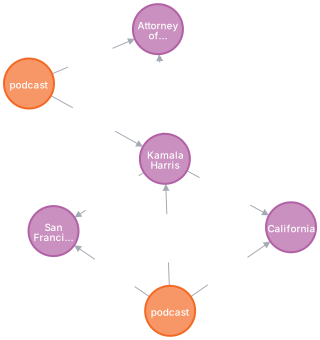
🎯 What Makes Graphiti Different
🕰️ Bi-Temporal Tracking
Every fact in Graphiti has a validity window: "Kendra loves Adidas shoes (as of March 2026)." If she switches to Nike in July, Graphiti knows — the old fact doesn't disappear, it just stops being current. This means you can ask "what did we know about Kendra in May?" and get an accurate answer.
🔍 Hybrid Retrieval — Not Just Vector Search
Most RAG systems rely purely on semantic search (embeddings). Graphiti combines semantic search + keyword search + graph traversal in one query. You get the nuance of vectors, the precision of keywords, and the relationship awareness of graph paths. Sub-second latency even on large datasets.
🔄 Automatic Fact Invalidation
This is the killer feature. When new data contradicts old data, Graphiti doesn't just overwrite — it invalidates the old fact and creates a new one, keeping full history. Your agent never has to guess whether a fact is still current.
📦 Multiple Graph Backends
Neo4j, FalkorDB, Amazon Neptune — pick your poison. Graphiti supports them all through a unified API. I tested with FalkorDB (easy Docker setup) and it worked out of the box.
💡 Who Is This For?
This is for you if: You're building AI agents that need to remember what happened and when it happened. Customer support bots that track user history. Personal assistants that learn preferences over time. Research agents that need source attribution.
This is NOT for you if: You need a simple vector store for document Q&A. Graphiti is overkill for basic RAG — use Chroma or Pinecone. It's specifically designed for relationship-rich, time-sensitive data.
⚡ Quick Start
Getting Graphiti running is straightforward:
Step 1: Set up a graph backend
# FalkorDB (easiest)
docker run -p 6379:6379 -p 3000:3000 -it --rm falkordb/falkordb:latest

# Neo4j
docker run -p 7687:7687 -p 7474:7474 -e NEO4J_AUTH=none neo4j:5.26
Step 2: Install and run
pip install graphiti-core
# or
docker pull zepai/graphiti:latest
Step 3: Build your first context graph
from graphiti_core import Graphiti
from graphiti_core.nodes import Episode

# Initialize with your graph backend
graphiti = Graphiti("neo4j://localhost:7687", "openai-api-key")

# Add episodes
episode = Episode(
    name="user-preferences",
    body="Kendra loves Adidas shoes, lives in Berlin, and works as a designer"
)
graphiti.add_episode(episode)

# Search with temporal awareness
results = graphiti.search("What are Kendra's preferences?")
📊 My Honest Take
After a week of using Graphiti, I'm genuinely impressed but also aware of the rough edges. The documentation is excellent — the README alone is worth the price of admission with clear examples and architecture diagrams. The core concept is rock-solid: temporal fact tracking is something every agent framework needs, and Graphiti does it right.
On the flip side, setup is more involved than a typical RAG tool — you need a graph database (Neo4j or FalkorDB) plus an LLM API key. The Python package has a few dependencies that can clash if you're in a complex environment. And if your use case is simple document Q&A, you're better off with a vector database.
But for agent memory, user profiling, and temporal knowledge management — this is the best open-source option I've found. The fact that it's powering Zep's production infrastructure (Zep is the managed version) gives me confidence in its scalability.
🎬 Wrapping Up
Graphiti solves a real problem that most agent frameworks ignore: facts change over time, and your agent needs to know that. If you're building agents that interact with users over weeks or months, this isn't optional — it's foundational.
🚀 Explore Graphiti on Run This Ai
Docker Compose configs, system requirements, installation guides, and more — all in one place.
View Graphiti Tool Page →