ActiveWorkflow: Programmable Workflow Automation Without Vendor Lock-In
ActiveWorkflow is an open-source workflow automation platform that lets you program business logic as code-driven agents — self-contained microservices in any language — with scheduling, state management, and a rich web UI.

What Is ActiveWorkflow?
ActiveWorkflow is an open-source workflow automation platform designed for teams who want to program their business logic without being boxed into a no-code environment. Unlike tools like n8n or Make that rely on visual drag-and-drop interfaces, ActiveWorkflow takes a code-first approach: you write agents as self-contained microservices in any programming language, and the platform handles scheduling, state management, logging, and orchestration.
The platform is built with Ruby on the backend and offers a clean web UI for managing workflows, inspecting logs, and monitoring execution. It sits alongside your existing stack rather than replacing it, making it an excellent choice for engineering teams that already have services, APIs, and databases in production.
Key Features
- Code-First Agents — Write agents in any language (Ruby, Python, Node.js, Go, etc.) as independent microservices
- Flexible Scheduling — Schedule workflows for periodic execution, event-driven triggers, or polling intervals
- Rich Web UI — Manage workflows, review execution logs, and monitor agent status through a polished dashboard
- State Management — Built-in state persistence so agents can pick up where they left off
- Extensive Logging — Every execution is logged with full visibility into agent communication
- Docker Native — Deploy with a single command using the official Docker image
- MIT Licensed — Fully open source with no restrictions on commercial use
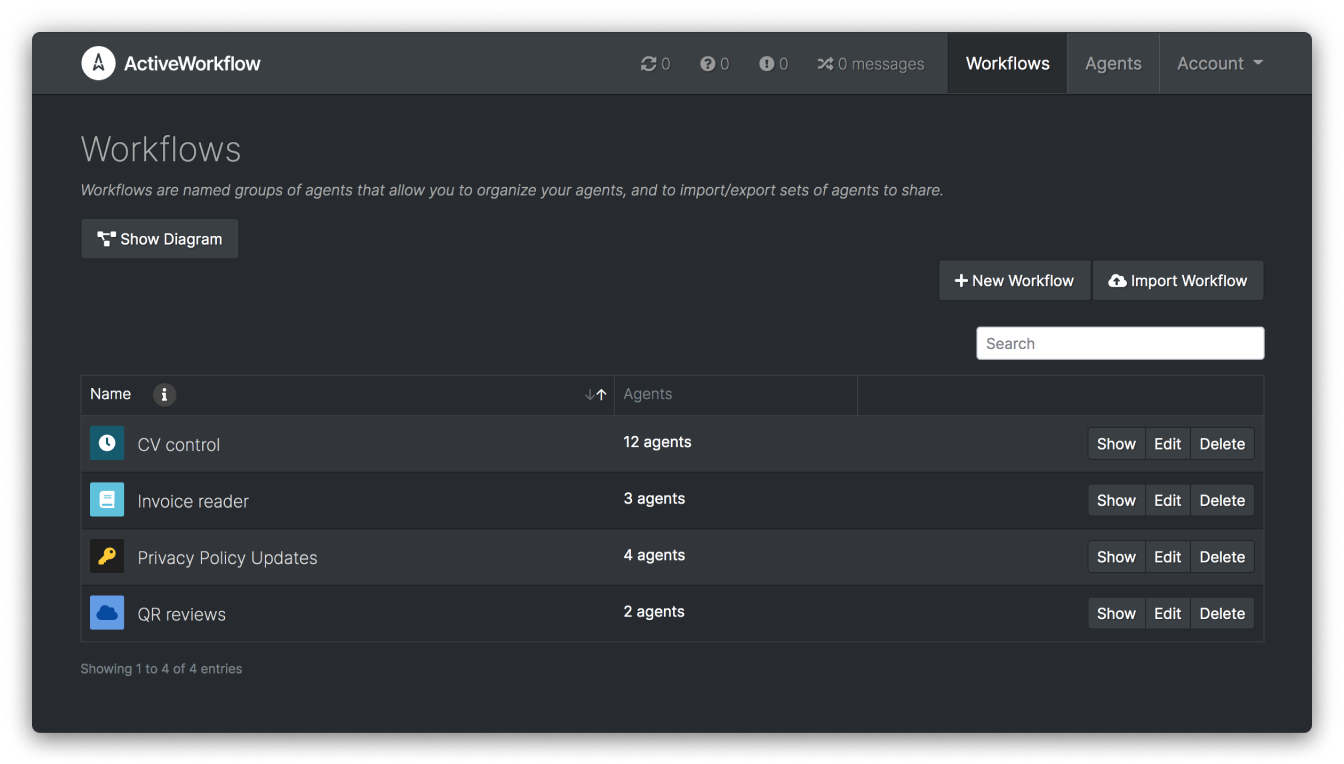
How It Works
At its core, ActiveWorkflow lets you define workflows composed of agents. Each agent is a self-contained service that performs a specific task — fetching data from an API, generating a PDF, sending an email, transforming a file, or calling an LLM. Agents communicate through the platform, passing data between workflow steps. You define the schedule: run every hour, trigger on an event, or poll for changes.
This architecture is ideal for teams that need reliability, observability, and the flexibility to use the best tool for each job. Because agents are standard HTTP services, you can test them independently, deploy them in any language, and integrate with any third-party API.
Why Self-Host ActiveWorkflow?
Self-hosting ActiveWorkflow gives you complete control over your automation infrastructure. Your data never leaves your network, you can customize the platform to your needs, and there are no per-workflow or per-agent pricing tiers. With Docker, deployment is a one-liner, and scaling is as simple as running more agents.
Conclusion
ActiveWorkflow fills a unique niche in the automation landscape: it is for developers who want programmable, code-defined workflows without the constraints of no-code platforms or the complexity of enterprise orchestration tools. If your team writes code and needs reliable automation, ActiveWorkflow is worth a serious look.