Camel-AI: The Pioneer Multi-Agent Framework Powering the Next Generation of Agentic AI
Discover Camel-AI, the pioneering open-source multi-agent framework with 17k+ stars. Learn how role-playing agents collaborate to solve complex tasks, generate training data, and build agent societies.
What Is Camel-AI?
Camel-AI (Conversational Agent Memory and Evolution Loop) is the first and most influential open-source multi-agent framework, developed by the CAMEL-AI research group. With over 17,000 stars on GitHub, it has become the foundational toolkit for studying how AI agents communicate, cooperate, and learn together. Unlike single-agent frameworks, CAMEL is designed from the ground up to simulate entire societies of agents engaging in complex, goal-oriented conversations.
Why Multi-Agent Matters
The key insight behind CAMEL is that complex tasks often require multiple specialized agents working together — just like a human team. One agent might be a researcher, another a coder, and a third a reviewer. CAMEL provides the infrastructure to orchestrate these role-playing agents, enabling them to delegate subtasks, share context, and converge on solutions that no single agent could achieve alone.
Key Features
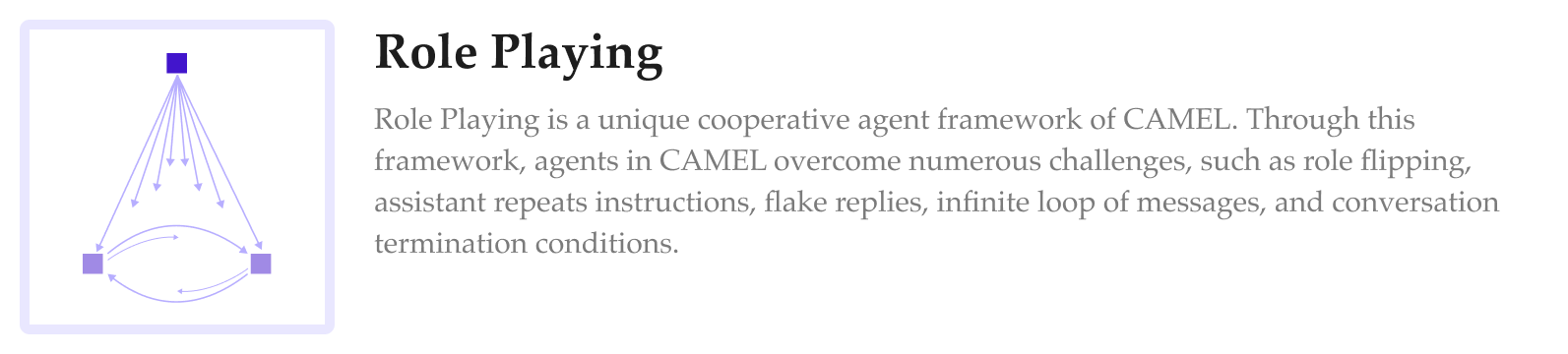
Role-Playing Architecture: Define agents with distinct personas (e.g., Task Specifier, Task Planner, Executor) that collaborate in structured conversations. Each agent has its own system prompt, memory, and tool set.
Data Generation Pipelines: CAMEL excels at generating high-quality training data. Its built-in pipelines include Chain-of-Thought generation, Self-Instruct, and Source2Synth — turning raw documents into structured Q&A pairs for fine-tuning.
Self-Improving Agents: Agents can reflect on their outputs, critique themselves, and iteratively improve — a critical capability for production-grade autonomous systems.
Multi-LLM Support: Works with OpenAI, Anthropic, Google, and open-source models via a unified interface, making it easy to experiment across providers.
Use Cases
CAMEL is used in research labs for studying emergent agent behaviors, in startups for automating complex workflows, and in enterprise for synthetic data generation and automated code review. Its flexible architecture makes it suitable for everything from simple two-agent debates to elaborate multi-agent software development simulations.
Conclusion
If you are building anything beyond a single-agent chatbot, Camel-AI is the framework to study and build upon. It is the research-backed foundation that many modern multi-agent systems trace their lineage to. Licensed under Apache-2.0 and actively maintained by a vibrant community, it remains the definitive starting point for anyone serious about multi-agent AI.