Letta: Building Stateful AI Agents with Self-Editing Memory
Letta (formerly MemGPT) gives AI agents self-editing memory with an OS-inspired architecture. Explore its memory hierarchy, the ADE, and why 24K+ developers self-host it.
Most AI agents forget everything between sessions. Every new conversation starts from zero, and your agent never gets smarter about you. Letta (formerly MemGPT) solves this with a fundamentally different architecture: agents that own their memory and edit it themselves, exactly like an operating system pages data between RAM and disk.
🚀 Want to deploy Letta yourself?
Docker configs, system requirements, and installation guides — all on one page.
View Letta Tool Page →What makes Letta different?
Standard agents stuff everything into a giant prompt window. Letta instead maintains a memory hierarchy: a small core memory that always stays in context, plus large external memory blocks that the agent can read, write, and reorganize on its own. This keeps context costs low while letting the agent accumulate knowledge across thousands of conversations.
Core capabilities
| Feature | What it gives you |
|---|---|
| Self-editing memory | Agents learn and improve without retraining |
| Stateful sessions | Persistence across chats and restarts |
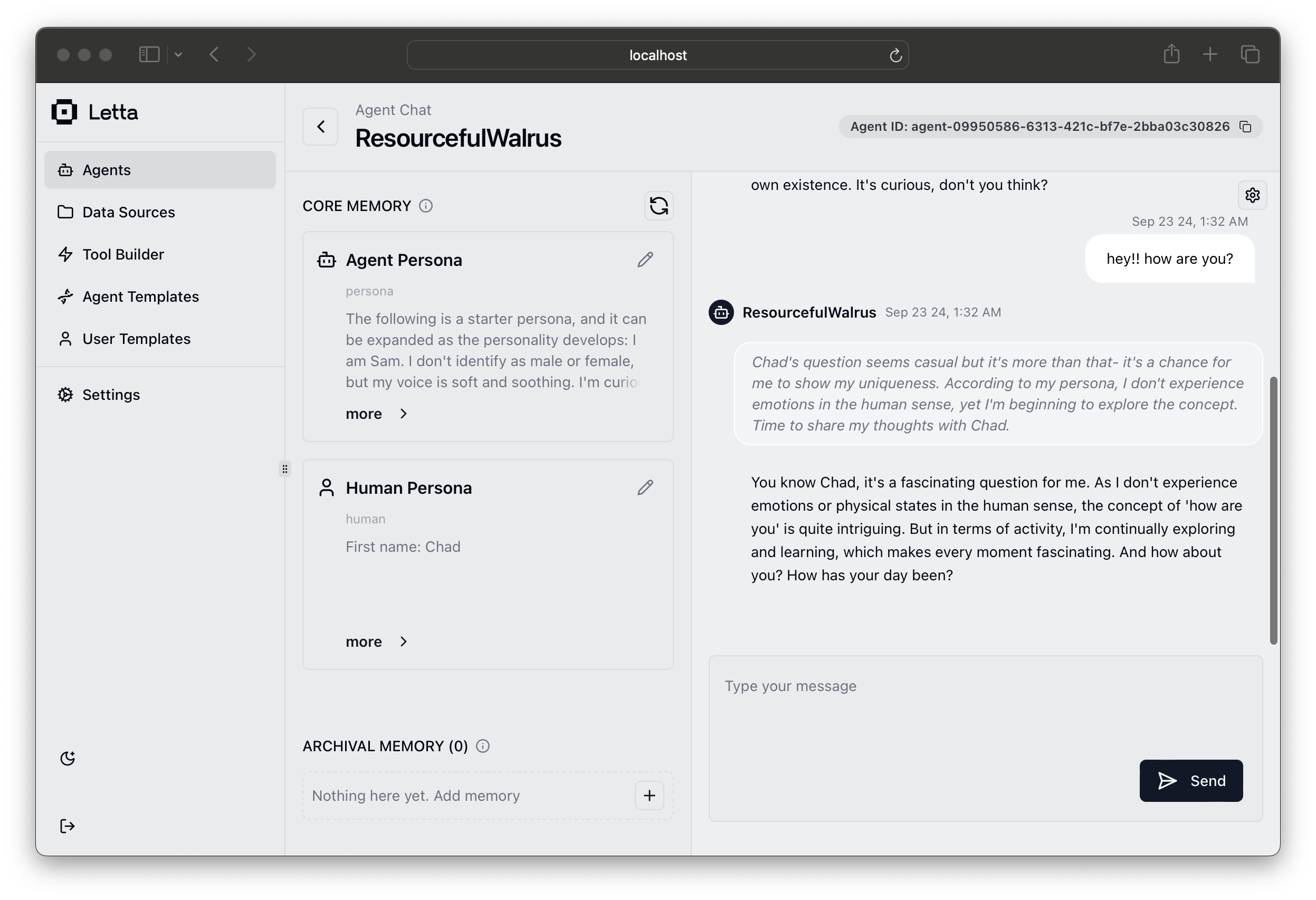
| ADE built in | Chat UI, memory inspector, agent builder |
| Flexible LLM support | OpenAI, Anthropic, local models via Ollama |
Because it's Apache-2.0 licensed with 24K+ GitHub stars, Letta has a large community, active plugin ecosystem, and a managed cloud option when you don't want to run your own infrastructure. Whether you're building a personal assistant, a customer-support agent, or a research copilot, the self-editing memory model changes what's possible.
🚀 Ready to run Letta?
System requirements, Docker compose files, and deployment notes — everything in one place.
View Letta Tool Page →