Mesh LLM: A Complete Guide to Distributed Self-Hosted AI
Mesh LLM turns your hardware into a private or public AI mesh. Here is how distributed inference works, what the Rust-based platform offers, and why it matters for self-hosters.
🚀 Want to deploy Mesh LLM yourself?
Docker configs, system requirements, and installation guides — all on one page.
View Mesh LLM Tool Page →What is Mesh LLM?
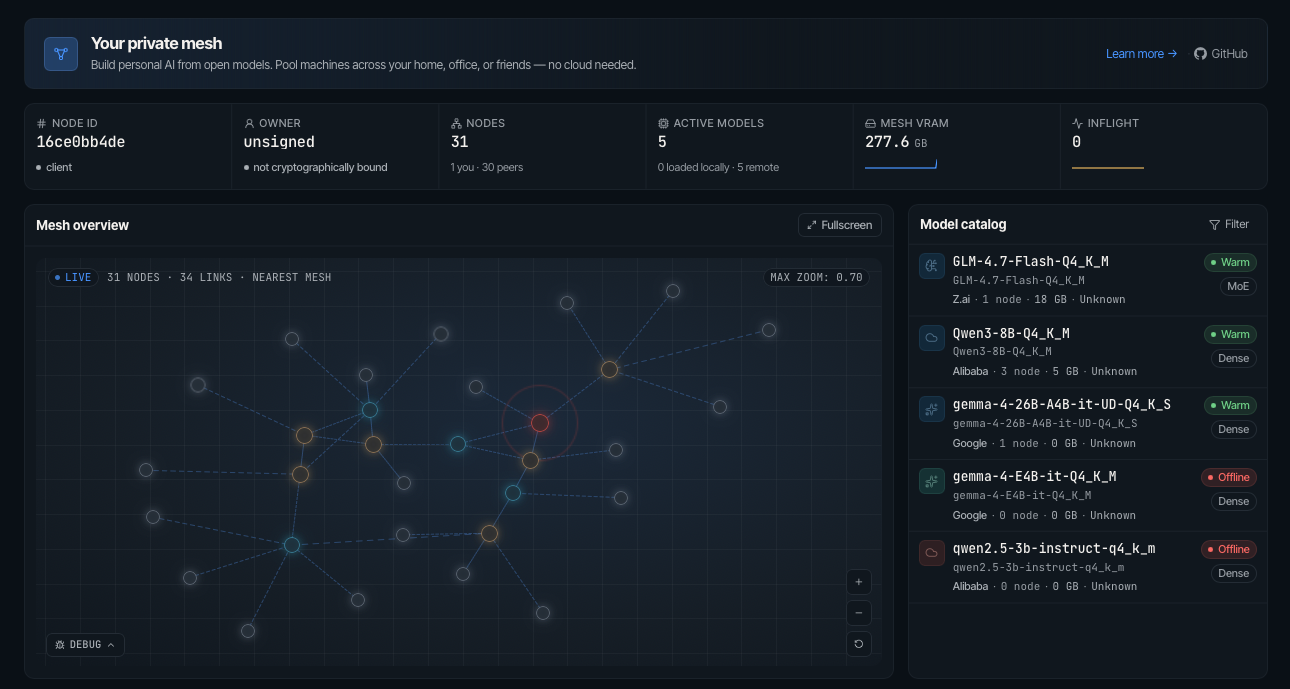
Mesh LLM is a distributed AI platform built in Rust that lets you share compute privately or publicly to power your own agents and chat applications. Instead of renting GPUs from a single cloud provider, you create a mesh of nodes — your laptop, a home server, a VPS — and route inference requests across them as one cooperative network.
Why a Mesh, Not a Cluster?
Traditional self-hosting runs one model on one machine. A mesh treats every participating node as a peer: one node can handle the web console and API, while others contribute raw compute. The platform handles routing, health checks, and workload distribution, so you can start small and add machines as your agents grow.
Key Features
| Feature | Benefit |
|---|---|
| Private or public mesh | Fine-grained control over what you share |
| Open-weight LLMs | Run models you trust, fully self-hosted |
| Web console | Manage nodes and chat from the browser |
| Headless API mode | Rust-powered server for agent integrations |
Who Is It For?
Homelab owners with spare GPUs, teams that want a private LLM backend behind their own firewall, and developers building agents that need elastic compute — all without sending prompts to third-party APIs. The Apache-2.0 license keeps it fully open source.
🚀 Want to deploy Mesh LLM yourself?
Docker configs, system requirements, and installation guides — all on one page.
View Mesh LLM Tool Page →