RagApp: The Simplest Way to Deploy Agentic RAG in Your Own Cloud
RagApp makes RAG deployment simple — one Docker command gives you a full LlamaIndex-powered RAG system with Admin UI, Chat UI, and REST API. Self-hosted, private, and open source.

💡 Tired of Complex RAG Setups? RagApp Changes That
I've spent way too many hours wrestling with RAG pipelines. You know the drill — spinning up vector databases, wiring up embedding models, configuring chunking strategies, writing boilerplate query code. It's a lot of moving parts just to answer questions about your documents.
Then I found RagApp. And honestly? I was skeptical. "Another RAG framework that promises simplicity but delivers complexity" — I've been burned before. But RagApp is different. It's literally a Docker pull away from a working RAG system.
🚀 Want to deploy RagApp yourself?
Docker Compose configs, system requirements, and deployment guides — all on one page.
View RagApp Tool Page →What Exactly Is RagApp?
RagApp is an open-source RAG platform built on LlamaIndex. Think of it as OpenAI's custom GPTs — but fully self-hosted on your own infrastructure. No data leaving your servers, no API keys sending your documents to third parties, no vendor lock-in.
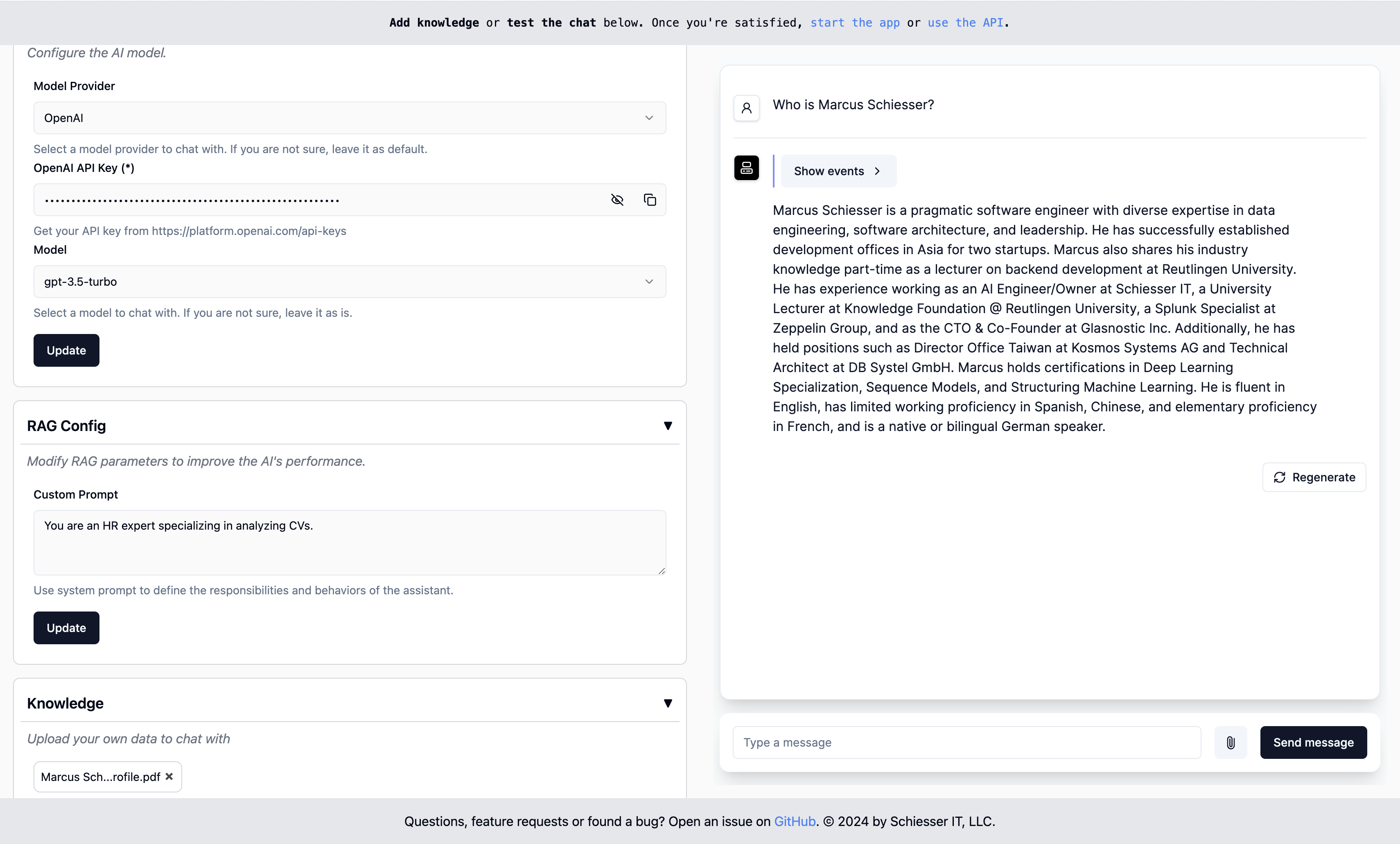
It gives you three interfaces out of the box:
- Admin UI — Configure your RAG pipeline, manage data sources, tune chunking and retrieval settings
- Chat UI — A clean interface for end users to ask questions and get answers from your knowledge base
- REST API — Integrate RAG programmatically into your own apps and workflows
What I Actually Liked
The simplicity is real. One command — docker run -p 8000:8000 ragapp/ragapp — and you have a working RAG system. No Python environment setup, no dependency hell, no "it works on my machine." I timed it: from pulling the image to asking my first question, under 2 minutes.
Pick your models. You can use hosted models (OpenAI, Gemini) or run everything locally via Ollama. I tested with both GPT-4o and Llama 3 — hot-swapping between them in the admin UI took seconds.
Clean architecture. It's built with TypeScript on the frontend and Python (LlamaIndex) on the backend. The codebase is well-structured — easy to extend if you need custom retrievers or rerankers.
What Could Be Better
No built-in auth. RagApp doesn't come with authentication. The README is clear about this — it expects an API Gateway in front. For production, you'll need to add something like Nginx + OAuth or deploy behind a reverse proxy. For a local/dev setup, this isn't an issue.
Last updated late 2024. The latest Docker tag (v0.1.5) is from November 2024. The core works fine, but some newer LlamaIndex features aren't baked in. It's not abandoned — the repo is still active — but development pace is deliberate.
Who Is RagApp For?
| ✅ Good for | ❌ Not ideal for |
|---|---|
| Teams who want RAG running fast without custom code | Advanced RAG needs (agentic routing, multi-hop queries) |
| Enterprises needing self-hosted, private document Q&A | Large-scale production with thousands of users |
| Developers prototyping RAG for clients or demos | Teams needing built-in SSO or user management |
Honest Verdict
RagApp does exactly what it says: it's the easiest way to deploy Agentic RAG in your own infrastructure. It won't replace a custom-built RAG system for complex use cases, but for 80% of RAG needs — document Q&A, internal knowledge bases, customer support assistants — it's more than enough.
What won me over is the Docker-first approach. No pip installs, no virtualenvs, no "but it needs Python 3.10 specifically." You pull, you run, you configure. That's refreshingly rare in the AI tooling space.
🚀 Explore RagApp on Run This Ai
Docker Compose configs, system requirements, installation guides, and more — all in one place.
View RagApp Tool Page →