txtai: The All-in-One Embeddings Database for AI-Powered Semantic Search and RAG
Discover txtai — the all-in-one open-source embeddings database for semantic search, vector indexing, and RAG. Self-hosted, Python-native, and zero external dependencies.

What Is txtai?
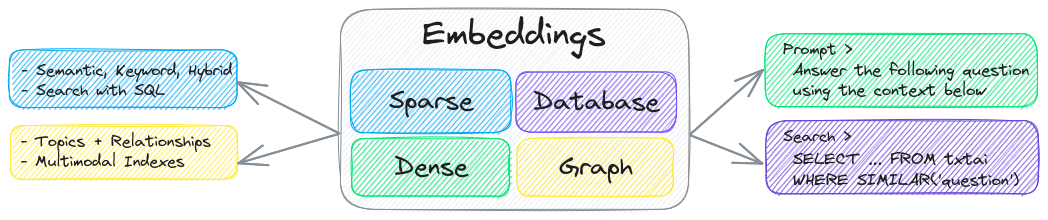
txtai is an all-in-one open-source embeddings database that brings together vector indexing, semantic search, and retrieval-augmented generation (RAG) in a single, unified framework. Built entirely in Python, txtai eliminates the need to stitch together multiple libraries and services when building AI-powered search and knowledge applications. Whether you are building a document search engine, a chatbot with memory, or a full RAG pipeline, txtai provides everything out of the box with zero external dependencies.
Key Features
At its core, txtai provides a complete embeddings-first architecture. It supports multiple embedding backends including Transformers, Sentence Transformers, and ONNX — giving you the flexibility to choose the right model for your accuracy and latency requirements. The built-in vector database indexes embeddings locally using a fast Approximate Nearest Neighbor (ANN) index, meaning you do not need a separate vector database service like Pinecone or Weaviate.
txtai goes beyond simple embeddings with its built-in workflows system. You can chain together content extraction, translation, summarization, and semantic search into automated pipelines. It also includes a full REST API, making it easy to integrate into any application stack. With an Apache-2.0 license and over 9,000 GitHub stars, txtai is production-tested and community-supported.
Why Self-Host txtai?
Running txtai on your own infrastructure gives you complete control over your data and vectors. There are no API calls to external services, no data leaving your network, and no per-query pricing. For organizations with sensitive documents, compliance requirements, or high query volumes, self-hosting txtai can dramatically reduce costs while improving privacy and latency.
Use Cases
Semantic Document Search: Index thousands of PDFs, Word documents, or web pages and search them by meaning rather than keyword matching. RAG Pipelines: Feed retrieved context to any LLM for grounded question answering without hallucinations. Knowledge Bases: Build an internal wiki that understands natural language queries. Content Workflows: Automatically translate, summarize, and classify incoming content using txtai workflows.
Conclusion
txtai is a Swiss Army knife for anyone working with embeddings and semantic search. Its all-in-one design — combining embeddings, vector storage, RAG, and workflows — makes it one of the most versatile tools in the AI ecosystem. Whether you are a solo developer building a side project or a team deploying production RAG, txtai deserves a spot in your stack.